Pickleball looks gentle. A smaller court, an underhand serve, a plastic ball with holes in it. Half the people playing seem to be laughing.
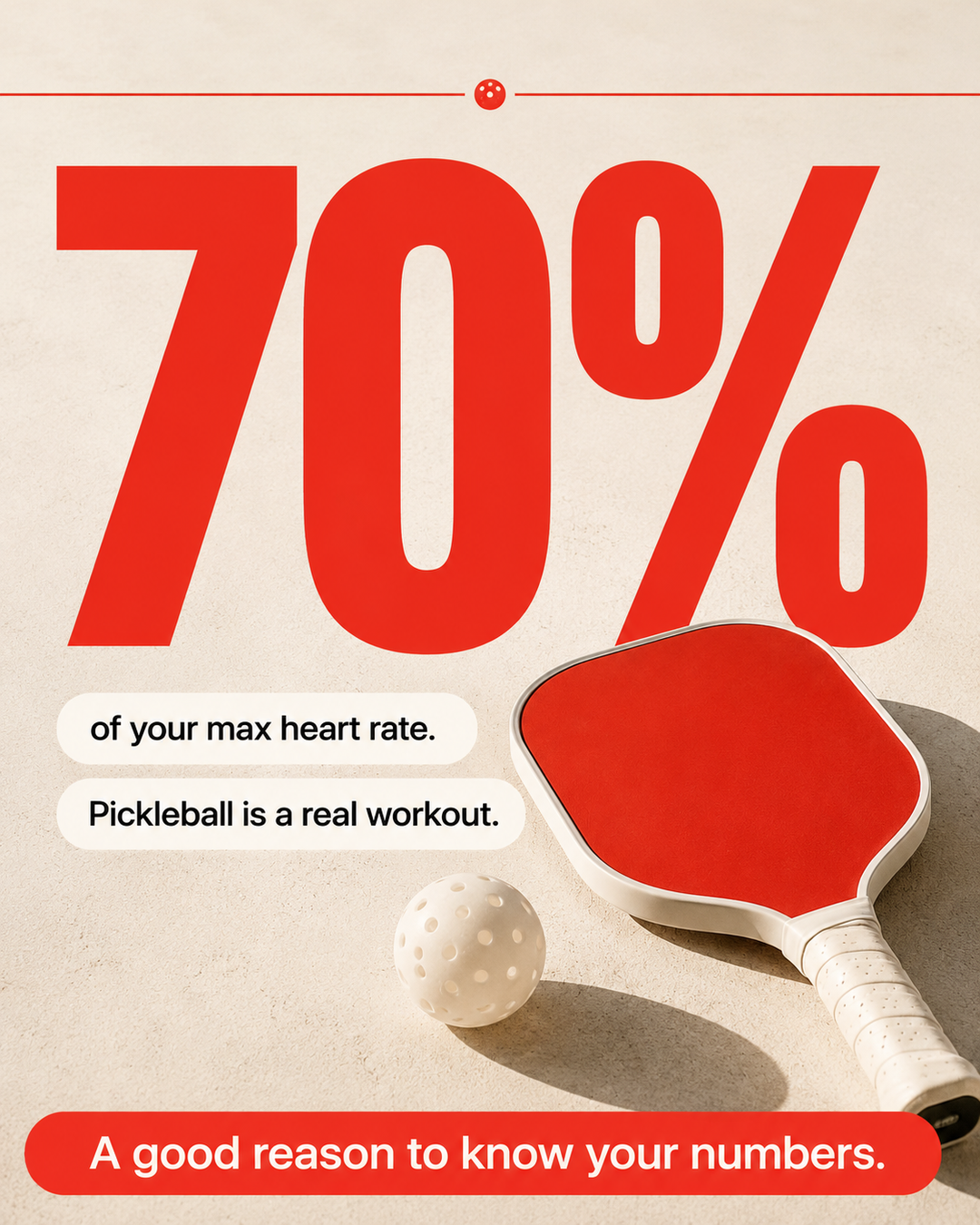
Your heart sees a different game. When researchers put heart-rate monitors on recreational players in their fifties, sixties, and seventies, the average player spent most of the match at moderate to vigorous intensity, hovering near 70% of predicted maximum heart rate. That is real exercise, the kind cardiologists spend whole careers asking patients to get more of.
It is also a reason to know what your heart is doing before you ask more of it. Here in metro Atlanta, where new courts seem to open every season, the question has gotten a lot less hypothetical.
How intense is pickleball, really?
Most people judge a workout by how it feels, and pickleball hides its work well. The court is small, the rallies look casual, and the social rhythm of the game reads more like a cookout than a cardio session. Underneath, the sport is built from hundreds of short bursts: accelerate, plant, reach, reset. Your heart rate climbs during the burst and never quite settles before the next one begins.
That stop-and-start pattern is why researchers classify the sport as moderate to vigorous activity, the same band that holds brisk walking at one end and jogging at the other. The CDC’s physical activity guidance notes that even a single session of moderate to vigorous activity can lower blood pressure in the hours afterward, and that regular sessions reduce the risk of heart disease, stroke, and type 2 diabetes. None of it requires a gym membership. For roughly 24 million Americans, it apparently requires a paddle.
What happens when players wear heart monitors
The most-cited measurement of pickleball intensity comes from a study in the Journal of Aging and Physical Activity. Researchers recruited 53 recreational players with an average age of 62 and wired them up twice over: a watch sampling heart rate every second, and a research-grade accelerometer at the hip tracking movement independently. Then they let them play real games, at least an hour at a time.
The numbers surprise people who think of pickleball as a pastime. Average heart rate landed around 111 beats per minute in both singles and doubles, which worked out to roughly 70% and 71% of predicted maximum. Peak heart rates pushed past 140. About 72% of active playing time sat in moderate or vigorous zones. Singles players covered more ground, logging over 3,300 steps an hour, yet doubles matched them on heart rate almost exactly. The intensity comes from the bursts, not the mileage.
The authors ran the guideline math too: about four and a half hours of pickleball a week meets the federal target of 150 minutes of moderate to vigorous activity.
A fair reading includes the fine print. This was a small study of mostly intermediate players, and it did not track medications. Beta-blockers, which many cardiac patients take, blunt heart-rate response, so your numbers on the court may tell a different story than your neighbor’s. That is not a flaw in the sport. It is a reason the smartest first step in a new pickleball habit sometimes runs through a cardiologist’s office.
The boom, by the numbers
In 2025, 24.3 million Americans played pickleball, up from 4.2 million in 2020, and the sport has now been the country’s fastest growing for five straight years. The committed core grew even faster: players who pick up a paddle at least eight times a year went from 1.4 million to 7.5 million over the same stretch. The national court count has reached 82,613, with more than 14,000 added in a single year.
Metro Atlanta is keeping pace without breathing hard. Gwinnett County approved six new lighted courts at Bethesda Park in Lawrenceville this spring, expanding the county’s inventory to 30 dedicated courts, with two more six-court projects underway at West Gwinnett Park and Lenora Park. ALTA, Atlanta’s tennis institution, launched a pickleball league in 2023 with 4,000 members and passed 10,000 by 2025. The Georgia Games tournament brings players to Alpharetta this very month. The sport is not arriving here. It has arrived.
Which raises a quieter set of numbers. Nearly half of US adults have high blood pressure, and about 1 in 6 of them do not know it. Hypertension rarely announces itself. It gets found, usually at a checkup. In Georgia the stakes are plain: cardiovascular disease is the state’s leading cause of death, claiming more than 28,000 lives a year, and CDC county-level analysis has flagged northeastern Georgia in particular for high hypertension prevalence and low control.
Hold those two facts side by side. The fastest-growing sport in America is pulling millions of adults over 50 into genuinely demanding exercise, in a region where a meaningful share of them carry a risk nobody has measured. Both things are true. Only one of them is fixable in a twenty-minute appointment.
The warning signs players miss mid-game
A competitive game is a terrible place to listen to your body. Down 9-7 in July heat, every signal has an alibi: winded because it is humid, dizzy because you skipped lunch, tired because you played three games back to back.
Sometimes that is the whole story. The Southeast thins the margins, though. The CDC reports that 61% of major Southeastern cities are seeing worsening heat waves, the highest share of any US region, and heat raises cardiac demand all by itself: the heart works harder to cool the body, and dehydration thickens the workload further.
So learn the difference between effort and warning. Breathlessness out of proportion to what you just did. Chest pressure or discomfort. Dizziness. A racing or fluttering feeling that outlasts the rally. None of these is automatically an emergency, and none of them is something to push through. The American Heart Association’s guidance on pickleball makes the encouraging point: the game can stay safe, even for people with diagnosed heart conditions, when players respect the signals and the heat. Pause. Find shade. Drink water. And if a signal repeats, treat it as information your doctor wants to hear.
What a heart check covers before you ramp up
The visit is simpler than most people expect. A heart check typically covers blood pressure, cholesterol, and heart rhythm, three numbers that can shift for years without producing a single symptom. Measured together, they turn guessing into knowing, and they give you a baseline to play against.
The long-game payoff for racquet sports shows up in the research. A 2026 analysis in BMJ Medicine followed more than 110,000 adults for decades and found that the most frequent racquet-sport players had a 15% lower rate of death from any cause than those who played least. The study tracked tennis and squash rather than pickleball, but the ingredients carry over: intervals, agility, and the social pull that keeps people showing up. For the days the court is rained out, our summer exercise guide covers ways to keep the same work going indoors.
This is prevention, not restriction. The goal is not to slow anyone down. It is to make sure your heart is ready for the season you are planning to give it.
Play hard, play safe
The best thing about the pickleball boom is the same thing that makes cardiologists pay attention to it: the game has pulled millions of people, many of them past 50, into real heart-pumping exercise, often for the first time in years. The sport found the players. A screening should find them too.
CardioVascular Group has board-certified specialists across eleven locations in metro Atlanta, which makes a check easy to fit in before your next open play. Get your heart checked, then go enjoy the game.
This content is for educational purposes only and is not intended as medical advice. Please consult your CardioVascular Group provider for personalized care.