
Catheter Ablation Procedure for Heart Arrhythmias in Gwinnett County, GA
When your heart develops an abnormal rhythm, it can affect your energy, your quality of life, and, if left untreated, your long-term health. Catheter ablation is a minimally invasive procedure designed to locate and eliminate the source of that abnormal electrical activity, restoring your heart to a normal rhythm without the need for open-heart surgery.
At CVG, catheter ablation is performed by our board-certified electrophysiology specialists, cardiologists with advanced subspecialty training in the heart’s electrical system, serving patients across Gwinnett County and the Atlanta metro. Whether you’re being treated for atrial fibrillation, atrial flutter, supraventricular tachycardia (SVT), or another heart condition, CVG’s electrophysiology team has the expertise and technology to guide you through the process with confidence.
With 11 cardiology centers across Gwinnett County and the Atlanta metro, expert electrophysiology care is always close to home.
How Catheter Ablation Works
During a catheter ablation procedure, a thin, flexible tube called a catheter is guided through a blood vessel, typically in the groin, to reach the heart. Once in position, the catheter maps the heart’s electrical activity to identify the precise area generating the abnormal signals. Energy is then delivered through the catheter tip to create small areas of scar tissue that block those signals, restoring a normal heart rhythm.
CVG’s electrophysiology specialists use two primary ablation techniques depending on your condition and anatomy:
Radiofrequency Ablation uses carefully controlled heat energy to create the scar tissue that interrupts the abnormal electrical pathway.
Cryoablation uses extreme cold to achieve the same result, an approach that some patients and physicians prefer for certain types of arrhythmia, including AFib.
Your CVG electrophysiologist will recommend the most appropriate technique based on your specific arrhythmia, medical history, and individual anatomy.
Conditions Treated with Catheter Ablation at CVG in Gwinnett County
Catheter ablation is used to treat a range of heart rhythm disorders. CVG’s electrophysiology team performs ablation for the following conditions:
Atrial Fibrillation (AFib)
AFib is the most common arrhythmia treated with catheter ablation. The procedure targets the pulmonary vein openings, the most frequent source of the abnormal electrical impulses that trigger AFib, creating a barrier that prevents those signals from disrupting the heart’s normal rhythm. For many patients, AFib ablation offers the potential for long-term rhythm control and a significantly improved quality of life. CVG’s Gwinnett County electrophysiologists perform AFib ablation using advanced 3D cardiac mapping for precise, targeted treatment.
Atrial Flutter
Atrial flutter is a rapid, regular abnormal rhythm originating in the right atrium. It is often treated with catheter ablation of the cavotricuspid isthmus, a small area of tissue in the right atrium, which has a high success rate and is typically a shorter procedure than AFib ablation.
Supraventricular Tachycardia (SVT)
SVT refers to a group of fast heart rhythm disorders originating above the ventricles. Common types include AVNRT, AVRT, and atrial tachycardia. Catheter ablation is considered a curative treatment for many forms of SVT, with high success rates and a low risk of recurrence.
Other Arrhythmias
CVG’s electrophysiology specialists also perform catheter ablation for ventricular tachycardia (VT), premature ventricular contractions (PVCs), Wolff-Parkinson-White syndrome (WPW), and other complex arrhythmias. Your electrophysiologist will determine whether ablation is appropriate for your specific condition.
Why Choose CVG for Your Catheter Ablation in Metro Atlanta
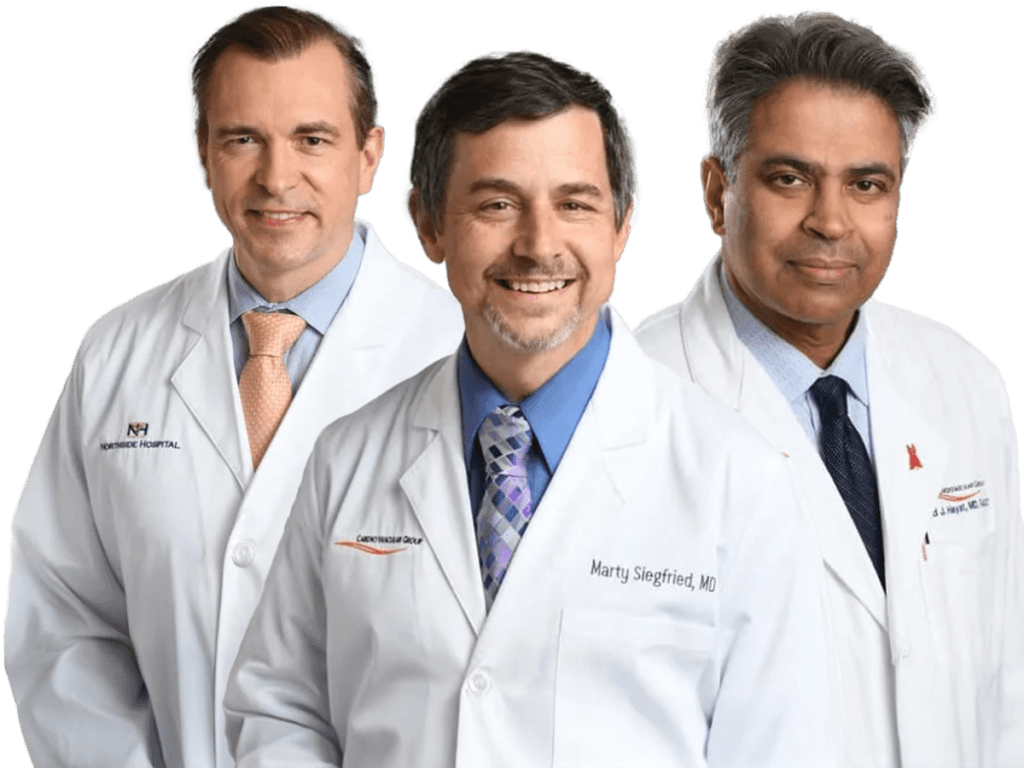
At Cardiovascular Group, our board-certified electrophysiologists bring advanced subspecialty training in cardiac arrhythmia management and extensive experience performing ablations across Gwinnett County and the Atlanta metro.
Subspecialty Electrophysiology Expertise You will be cared for by cardiologists who have dedicated their careers to heart rhythm disorders.
Minimally Invasive Approach No open-heart surgery, no large incisions. Most patients are discharged within 24 hours and return to normal daily activities within a week.
Advanced Mapping Technology CVG uses advanced 3D cardiac mapping to precisely locate the source of your arrhythmia before ablation begins, improving accuracy and reducing procedure time.
11 Locations Across Gwinnett County and the Atlanta Metro Expert electrophysiology care, close to home, with continuity of care across CVG’s full network of cardiology centers.
CVG has been caring for the hearts of Georgia patients since 1982. Trust your arrhythmia care to a team with the experience and commitment to get you back to living well.
Frequently Asked Questions
A catheter ablation, also known as cardiac ablation, is a procedure used to treat cardiac arrhythmias such as atrial fibrillation, atrial flutter, and Wolff-Parkinson-White syndrome. It is performed by guiding a thin tube to the heart that uses energy to create tiny scars in the heart. This is done to block abnormal electrical signals and restore a normal heart rhythm. The procedure can take two to four hours, and the patient is given medication to relax. Whether or not the patient is conscious during the process depends on the individual case.
Like any procedure, catheter ablation can have risks. However, they are extremely rare. Medical professionals perform catheter ablation in a hospital setting, and the patient is closely supervised throughout; the patient’s safety is a top priority. Cardiac ablations target only abnormal heart tissue. There is no significant impact on heart function.
Rapid electrical impulses from the pulmonary veins usually trigger atrial fibrillation or AFib. These are veins coming from the lungs that drain into the left atrium. Heart muscle-type cells in those veins have properties different from those of the rest of the heart allowing such rapid electrical activity. When we ablate atrial fibrillation, we either burn or freeze around the openings of those pulmonary veins to make a firewall that keeps those impulses from irritating the heart. In many situations, that is all that is required. However, ablation may be needed in more advanced atrial fibrillation in other areas.
AFib ablation is usually done with general anesthesia. Simple pulmonary vein isolation typically takes about two hours but can take significantly longer if additional ablation is required.
According to the National Institute of Medicine, catheter ablation for atrial fibrillation can be effective, though success rates typically range from 50–80% depending on the type of AF and whether multiple procedures are needed. Recurrences can be due to triggers from outside the pulmonary veins or to reconnection of the pulmonary vein muscle fibers to the left atrium. Depending on the severity of the recurrence, a repeat ablation procedure may be required.
Major complications are rare but can be serious. The most concerning are stroke, atrial esophageal fistula, and death. Blood clots usually cause strokes in the heart, and therefore, we prescribe anticoagulants around the time of ablation. A risk peculiar to atrial fibrillation ablation is damage to the esophagus, which passes directly behind the left atrium. In rare cases, a hole can form between the atrium and the esophagus, which can be lethal. We, therefore, monitor the esophageal temperature during ablation and prescribe acid blockers afterward to protect the esophagus.
Plan to stay overnight. You’ll rest for three hours after the ablation. You can move around afterward, but avoid heavy exertion for a week. Ablation aims to prevent atrial fibrillation, yet it may irritate, leading to irregular heartbeat. Depending on risk assessment, we may prescribe an antiarrhythmic drug. Expect mild chest discomfort for 2-3 days, managed with anti-inflammatory meds. Antacid therapy is provided for a month to protect the esophagus. Bruising at the puncture sites is common, usually local, but can extend down to the knee occasionally. Progressive pain or swelling at the sites may indicate continued bleeding. Immediate attention is needed for late-onset chest pain or pain on swallowing to prevent atrial esophageal fistula.
Find a CVG Electrophysiologist Near You in Gwinnett County
CVG’s board-certified electrophysiology specialists are ready to help you understand your options and take the next step toward better heart rhythm health. With 11 cardiology offices across Gwinnett County and the Atlanta metro, expert catheter ablation care is always close to home.
Lawrenceville (Main Office)
2200 Medical Center Blvd, Suite 400,
Lawrenceville, GA 30046
770.962.0399 | 770.290.8084
Duluth
3855 Pleasant Hill Road, Suite 250,
Duluth, GA 30096
770.962.0399 | 770.290.8084
Snellville
1608 Tree Lane, Building C,
Snellville, GA 30078
770.962.0399 | 770.290.8084